Few dinosaur matchups create as much excitement as T. Rex vs Spinosaurus. One is the legendary king of the dinosaurs, a bone-crushing land predator with a skull built like a biological battering ram. The other is the strange, sail-backed giant of ancient North Africa, longer than T. rex and shaped by a world of rivers, fish, mudbanks, and crocodile-like hunting opportunities. Put them together in the imagination, and the result is one of the greatest prehistoric battles ever debated. But this showdown is not as simple as asking which dinosaur was bigger. Tyrannosaurus rex and Spinosaurus were not built for the same job. They did not live in the same place. They did not even live at the same time. T. rex roamed Late Cretaceous North America around 68 to 66 million years ago, while Spinosaurus lived earlier in North Africa, roughly 99 to 94 million years ago. A real meeting never happened. Still, as a science-based thought experiment, the battle is fascinating. It forces us to compare bite force, body design, weapons, movement, senses, habitat, hunting style, and survival strategy. The real question is not simply “Who would win?” The better question is “Where would they fight, and which animal would control the battlefield?”
A: No. They lived millions of years apart on different continents.
A: Spinosaurus was likely longer, while T. rex was more compact and heavily built.
A: T. rex had the stronger known bite, especially for crushing bone.
A: In shallow water or a river ambush, Spinosaurus would have a better chance.
A: On dry land, T. rex likely had the advantage because of its bite, skull strength, and balance.
A: Scientists debate exactly how aquatic it was, but it was strongly tied to river habitats.
A: T. rex was probably better adapted for land movement, though exact speeds remain debated.
A: It mostly ate fish but may have also taken other animals near water.
A: It likely hunted and scavenged large dinosaurs in Late Cretaceous North America.
A: T. rex wins most dry-land scenarios; Spinosaurus has the edge in river or swamp conditions.
Meet Tyrannosaurus Rex: The Land King
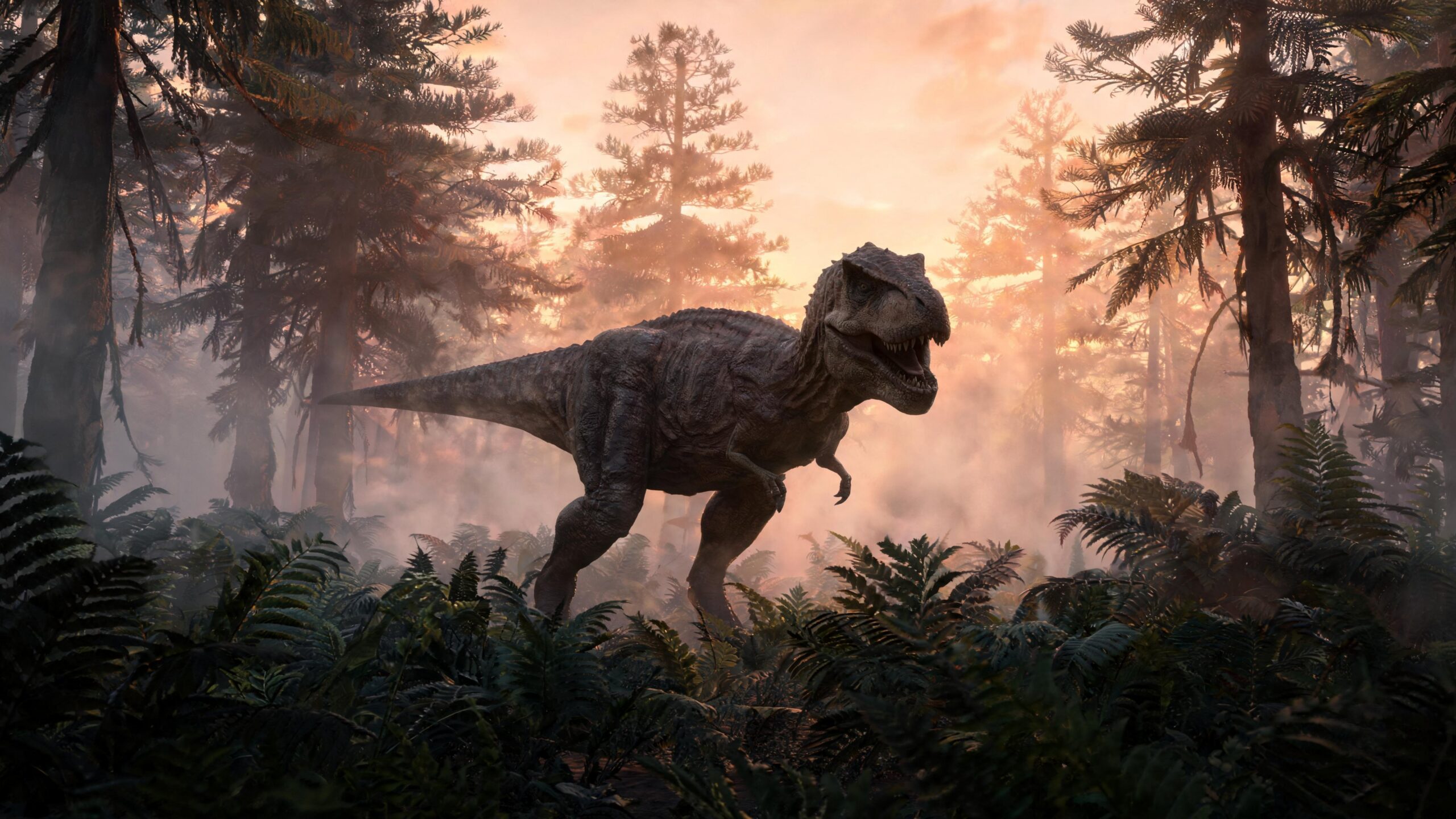
Tyrannosaurus rex was one of the most powerful land predators ever discovered. Its name means “tyrant lizard king,” and the title fits the animal’s reputation. A large adult T. rex could reach around 40 feet long, stand about 12 to 13 feet tall at the hips, and weigh several tons. Its body was balanced by a long heavy tail, its legs were built for supporting a massive frame, and its head was the center of its deadly design.
The skull of T. rex was deep, broad, and reinforced. Its teeth were thick, curved, serrated, and strong enough to withstand extreme pressure. Unlike predators that relied mainly on slicing flesh, T. rex could puncture deeply and crush bone. It was not carrying a delicate blade. It was carrying a demolition tool.
T. rex lived in ecosystems filled with large herbivores such as Triceratops, Edmontosaurus, and Ankylosaurus. These were not easy meals. Triceratops had horns and a massive skull. Ankylosaurus had armor and a tail club. Edmontosaurus could grow large and may have moved in groups. To survive among such prey, T. rex needed more than size. It needed power, senses, timing, and a bite that could end a fight quickly.
Meet Spinosaurus: The River Giant
Spinosaurus was one of the most unusual large theropod dinosaurs ever found. It lived in what is now North Africa, in environments that were once far wetter than today’s Sahara Desert. Instead of dry dunes, imagine broad rivers, deltas, mangrove-like habitats, giant fish, crocodile relatives, and muddy shorelines alive with danger.
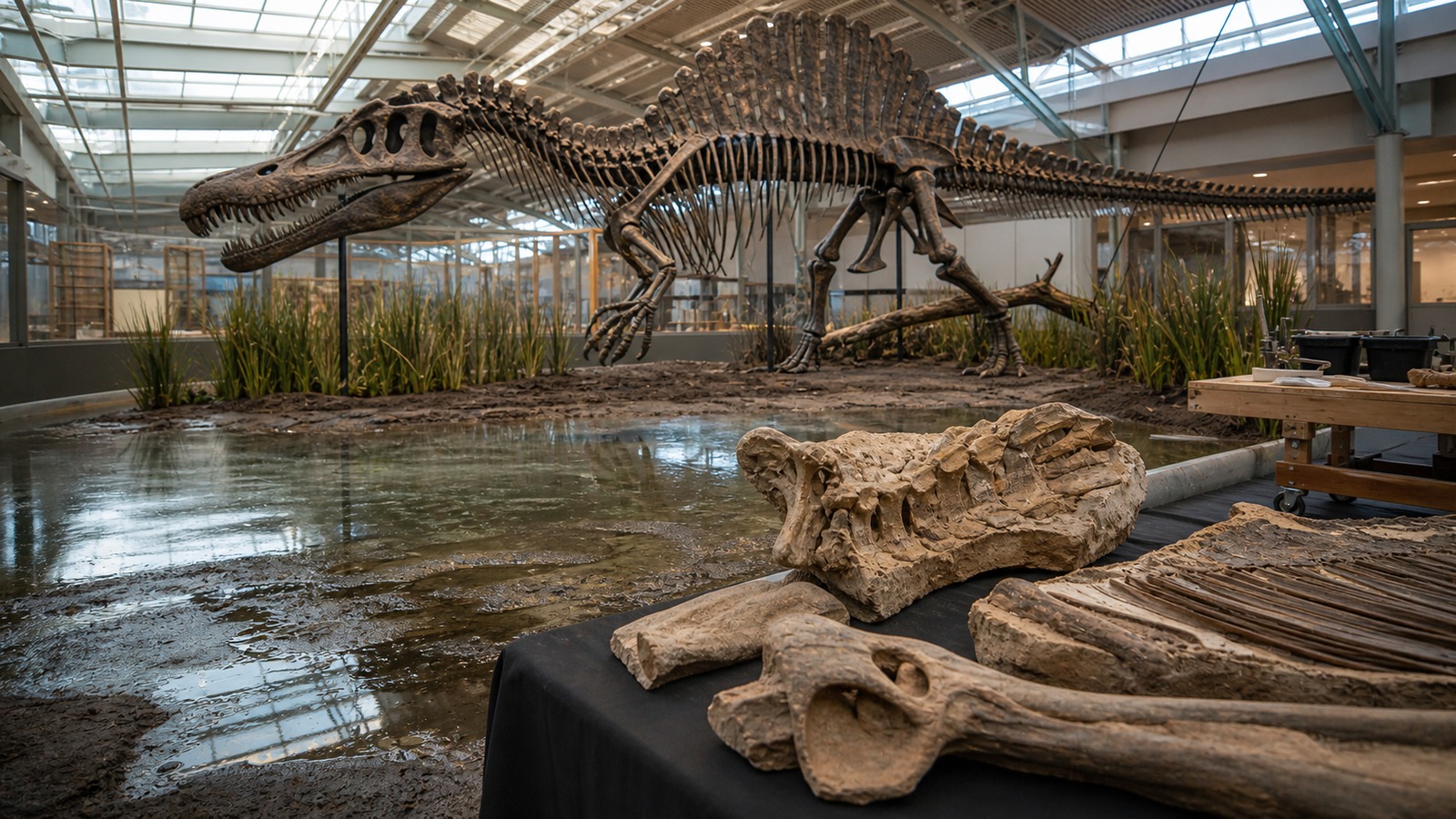
Spinosaurus was probably longer than T. rex, with some estimates placing it around 45 feet or more in length. Its most famous feature was the tall sail on its back, formed by long neural spines. Its skull was long and narrow, more like a crocodile’s than a T. rex skull. Its teeth were cone-shaped rather than blade-like, ideal for gripping slippery prey such as fish. Its nostrils were positioned farther back on the snout, and its body shows several adaptations tied to life near or in water. Spinosaurus was not a T. rex clone with a sail. It was a different kind of predator. It likely spent much of its time near rivers, hunting fish and possibly taking other animals that came too close to the water. It may have waded, ambushed, or swum to some degree, though scientists still debate exactly how aquatic it was. What is clear is that Spinosaurus belonged to the water’s edge in a way T. rex did not.
Size Comparison: Bigger Does Not Always Mean Better
At first glance, Spinosaurus seems to win the size contest. It was likely longer than T. rex, and its tall sail made it look even more imposing. In a visual matchup, Spinosaurus would appear strange, towering, and dramatic, especially if it rose from shallow water with its sail cutting the skyline.
However, length is not the same as fighting power. T. rex was shorter in total length but more compact, muscular, and skull-heavy. Its mass was concentrated in a body designed for terrestrial dominance. Spinosaurus had length, reach, and height, but its build was more specialized for aquatic or semi-aquatic feeding. In a direct pushing, biting, twisting land fight, compact power matters.
Think of the difference between a heavyweight wrestler and a long-bodied crocodile-like hunter. The longer animal can be dangerous, especially in the right environment, but the more compact animal may have the advantage in balance, leverage, and impact on land. So Spinosaurus likely wins the length category. T. rex likely wins the rugged land-combat category.
Bite Force: T. Rex’s Greatest Weapon
The most important advantage for T. rex is bite force. T. rex had one of the most powerful bites known from any land animal. Its jaws were not only strong; they were supported by a skull built to absorb and deliver tremendous stress. Its teeth were thick and serrated, capable of punching into flesh and damaging bone. In a battle, one clean T. rex bite to the neck, skull, spine, leg, or torso could change everything. This is the kind of weapon that does not need repeated fancy attacks. If T. rex landed a deep bite and held on, the damage could be catastrophic.
Spinosaurus had dangerous jaws too, but they were designed differently. Its long, narrow snout and conical teeth were better suited for catching fish and gripping prey than for crushing massive bones. That does not mean a Spinosaurus bite would be harmless. A large animal with a long jaw full of teeth is dangerous by default. But compared with T. rex, Spinosaurus was not the same kind of bone-crushing specialist. In a bite-to-bite contest, T. rex wins decisively.
Claws, Reach, and the Spinosaurus Advantage
Spinosaurus was not helpless in close combat. In fact, one of its biggest advantages may have been its forelimbs. Unlike T. rex, which had famously small arms, Spinosaurus had longer, more useful arms with large claws. These could have helped it grip prey, slash at close range, or stabilize itself near water.
Reach matters in a fight. A Spinosaurus could potentially keep its head back while using its longer body and forelimbs to create space. Its long jaws could strike from farther away than the shorter, deeper skull of T. rex. If the battle happened in water, Spinosaurus could use splashing, unstable footing, and its comfort in aquatic terrain to make the fight messy.
The sail may not have been a weapon, but it made Spinosaurus look larger and more intimidating. In animal conflict, display can matter. Many fights in nature end before either animal risks fatal injury. A huge sail-backed predator standing in water would be a terrifying sight even to another giant. Spinosaurus does not win the raw bite category, but it has advantages in reach, forelimb use, and water-based positioning.
Speed and Movement: Land vs Water
T. rex was not a lightweight sprinter, but it was built for life on land. Its strong hind legs, balanced posture, and compact center of mass made it a more stable terrestrial predator than Spinosaurus. T. rex likely moved efficiently across floodplains and forested environments. It did not need to run like a cheetah to be dangerous. It needed to close distance, choose the right moment, and deliver a crushing bite. Spinosaurus was more complicated. Its body shows adaptations connected to water, but its exact movement on land remains debated. It may have been capable along riverbanks and shallow wetlands, but it probably was not as balanced or powerful in a dry-land confrontation as T. rex. Its long body and sail could have made quick turning or rough terrain combat more difficult.
In shallow water, however, the situation changes. T. rex stepping into mud, current, or uneven riverbed terrain would lose some of its stability. Spinosaurus, more at home in that setting, could use the environment as a weapon. A land predator dragged into the wrong terrain becomes much less dominant. On dry land, T. rex has the movement advantage. In water or swampy ground, Spinosaurus gains the edge.
Intelligence and Senses
T. rex likely had excellent senses for a terrestrial predator. Its forward-facing eyes helped with depth perception, and studies of its skull suggest a strong sense of smell. This would have helped it locate prey, track carcasses, and understand its surroundings. A predator that large would not survive by brute force alone. It needed awareness. Spinosaurus also had specialized sensory equipment for its world. Its crocodile-like snout and aquatic lifestyle suggest an animal tuned to river environments. It may have detected movement near water, watched shorelines, and hunted in conditions where fish and other prey were abundant. Its sensory world was different from T. rex’s.
In a duel, T. rex may have had the better predator profile for open land. Spinosaurus may have had superior environmental awareness near water. The fight would not only be muscle against muscle. It would be instinct against instinct.
Scenario One: Dry Land Battle
On dry land, T. rex is the favorite. This is the environment where its body makes the most sense. Its legs are built for terrestrial movement, its balance is strong, its skull is reinforced, and its bite is devastating. It could approach, angle its head, and look for one fight-ending bite. Spinosaurus would still be dangerous. Its size, reach, claws, and long jaws could injure T. rex. A swipe from its forelimbs or a bite to the face could cause damage. But Spinosaurus would be fighting away from its strongest environment. Its long body and narrower jaws would be less effective against a compact predator built to absorb struggle and deliver massive bite trauma. If T. rex got inside the reach of Spinosaurus and landed a bite on the neck, skull, shoulder, or leg, the fight would likely swing quickly. Spinosaurus might try to retreat, turn, or create distance, but on dry ground T. rex would have the more reliable killing tools.
Winner on dry land: T. rex.
Scenario Two: Riverbank Battle
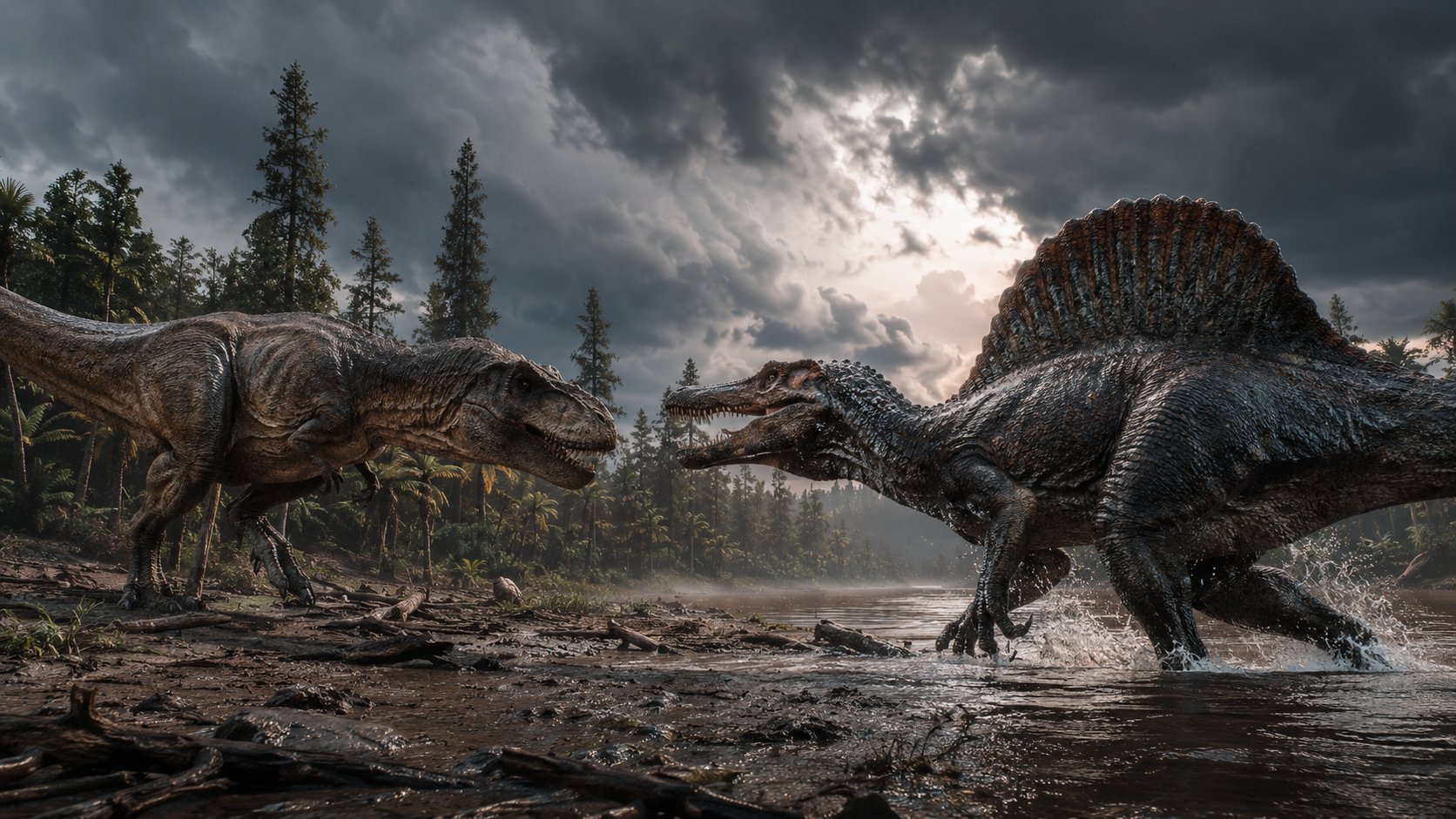
A riverbank battle is much closer. This is the kind of setting where both animals have options. T. rex can still use its land power if the ground is firm. Spinosaurus can use mud, water, and reach to make the fight more difficult.
Imagine T. rex approaching a carcass near the river while Spinosaurus rises from the shallows. The first moments matter. If T. rex charges onto firm bank and bites first, Spinosaurus is in danger. If Spinosaurus keeps to shallow water, forces T. rex onto unstable mud, and uses its long jaws and claws to harass from range, the fight becomes much less predictable. In this setting, Spinosaurus does not need to overpower T. rex in a wrestling match. It needs to prevent T. rex from landing the decisive bite. It could use water depth, footing, and angle to make T. rex hesitate. It could strike and withdraw, forcing the heavier land predator into bad terrain.
Winner at the riverbank: too close to call, with a slight edge depending on footing.
Scenario Three: Shallow Water Battle
In shallow water, Spinosaurus becomes the favorite. This is where its lifestyle matters most. If T. rex had to move through mud, current, or uneven submerged ground, its powerful legs would lose some of their advantage. A misplaced step could expose it to attack. Its heavy body, built for land balance, would become more vulnerable. Spinosaurus, by contrast, would be operating in familiar territory. It could use its body length, forelimbs, and water comfort to control the fight. Even if it could not crush bone like T. rex, it could avoid the strongest bite angles and attack from awkward positions. It might not need to kill T. rex outright. It could wound, exhaust, or drive it away. A T. rex bite would still be dangerous anywhere. If T. rex caught Spinosaurus by the neck or skull, the fight could end badly for the sail-backed giant. But in water, landing that perfect bite becomes harder.
Winner in shallow water: Spinosaurus.
The Realistic Answer: They Would Probably Avoid Each Other
In nature, giant predators do not casually risk death for entertainment. A serious injury can be fatal even if the animal “wins” the fight. A broken jaw, damaged leg, torn muscle, or deep infected wound could mean starvation later. Because of that, many large predators avoid unnecessary battles. If T. rex and Spinosaurus somehow crossed paths, the most realistic outcome might not be a dramatic fight to the death. They might posture, roar, snap, circle, and test each other. The animal in the worse position would likely retreat. If the confrontation happened over food, the hungrier or more confident animal might push harder, but neither would want to suffer a crippling injury. This does not make the matchup less exciting. It makes it more realistic. The winner might be decided before the first bite, based on confidence, terrain, hunger, size, health, and who controlled the best escape route.
Final Verdict: Who Would Win?
In a neutral dry-land fight, Tyrannosaurus rex would most likely defeat Spinosaurus. Its stronger bite, reinforced skull, compact build, and land-based combat stability give it the clearest path to victory. T. rex was built to bring down large terrestrial prey, and one well-placed bite could cause devastating damage. In a water-based fight, Spinosaurus would have the advantage. Its river-adapted body, long reach, useful forelimbs, and comfort in aquatic terrain would make it extremely dangerous in shallow water or muddy wetlands. If it could keep T. rex unstable and prevent a clean bite, Spinosaurus could win or force T. rex to retreat.
So the best answer is this: T. rex wins on land. Spinosaurus wins near deeper water. At the riverbank, the battle is a coin toss. The ultimate prehistoric battle is not just about which dinosaur was bigger or scarier. It is about adaptation. T. rex was the king of land predators. Spinosaurus was the giant of ancient river systems. Each ruled its own world. Put either one in the other’s kingdom, and the crown begins to slip.
Why This Battle Still Fascinates Us
T. Rex vs Spinosaurus remains one of the greatest dinosaur debates because it is really a clash of two different kinds of dominance. T. rex represents raw terrestrial power, the crushing bite, the deep skull, and the classic image of the apex predator. Spinosaurus represents mystery, size, strange anatomy, and the danger of a predator built for a watery world.
The matchup also shows why prehistoric creatures cannot be judged by size alone. Evolution does not create “better” animals in a simple ranking system. It creates animals suited to specific environments. A shark is not better than a lion, and a crocodile is not better than an eagle. Each is terrifying where it belongs. T. rex and Spinosaurus were both masterpieces of survival. They were not rivals in real history, but in imagination they create the perfect prehistoric question: what happens when the king of the land meets the monster of the river?
The answer depends on the ground beneath their feet.