Where Ruins End and Legends Begin
Ancient ruins have a way of changing the atmosphere around them. A broken temple deep in a rainforest, a stone city swallowed by sand, or a crumbling mountain fortress high above the clouds can feel more alive than many modern places. Even when no one stands within their walls, they seem to hold memory, presence, and warning. That is one reason hidden ruins have inspired so many stories about legendary creatures. Across the world, people have long believed that forgotten places are rarely abandoned. Instead, they are watched. In mythology, folklore, and cryptid-style storytelling, ruins are often described as protected by beings that are older than kingdoms and more patient than time. Some are dragons sleeping beneath buried gates. Some are serpent guardians coiled through temple foundations. Some are sacred beasts that appear only when intruders cross the wrong threshold. Others are shadow-like creatures, part spirit and part monster, tied to the ruin itself as if stone and guardian were created together. These legends do more than add excitement to old architecture. They reveal how people understand sacred places, lost civilizations, and the deep human fear of trespassing into what was never meant to be found. Hidden ruins are places where history disappears into mystery. Legendary guardians step into that mystery and give it shape.
A: Because ruins already carry mystery, sacred history, and danger, making them ideal settings for guardian myths.
A: Dragons and giant serpents are the most common, though sacred beasts and shadow guardians also appear often.
A: No; many are protectors with a purpose, defending relics, tombs, sacred chambers, or spiritual boundaries.
A: Sometimes, but just as often they guard knowledge, relics, tombs, gateways, or places considered holy or forbidden.
A: Their remoteness, silence, incomplete history, and concealed architecture make them feel watched even when empty.
A: A guardian has a duty tied to a place, which gives it meaning beyond simple destruction.
A: Serpents fit tunnels, sacred symbolism, underground spaces, and ancient ideas of hidden power remarkably well.
A: Yes; they likely helped discourage trespass, theft, grave robbing, and disrespect toward sacred sites.
A: Because they mix exploration, danger, mystery, history, and myth in one powerful narrative setting.
A: It suggests that the past is still alive, defended, and not easily given away to the present.
Why Hidden Ruins Attract Creature Legends
Ruins are natural homes for story. They are incomplete, silent, and often remote. A ruin tells us that something important once stood here, but it does not always tell us why it fell, what was hidden, or what was left behind. That uncertainty creates the perfect setting for tales of monsters and guardians.
Ancient people also understood the power of storytelling as protection. A sacred chamber beneath a temple, a royal tomb inside a mountain, or a sealed archive holding ritual knowledge was safer when others feared it. A warning etched into stone might be ignored. A story about a creature that punishes intruders is harder to forget. Over generations, practical warnings could grow into living legends.
The environment around hidden ruins adds to this effect. Jungle ruins disappear behind leaves and mist. Desert ruins shimmer under heat and illusion. Underground ruins echo with movement, drafts, and darkness. Mountain sanctuaries disappear behind clouds and sheer cliffs. These landscapes make ordinary experiences feel supernatural. A shadow becomes a beast. A sound becomes a warning. A collapsed passage becomes evidence that something still moves below. That is why legendary creatures are so often linked to ruins. A hidden ruin does not feel empty. It feels guarded.
Dragons of Buried Cities and Forgotten Gates
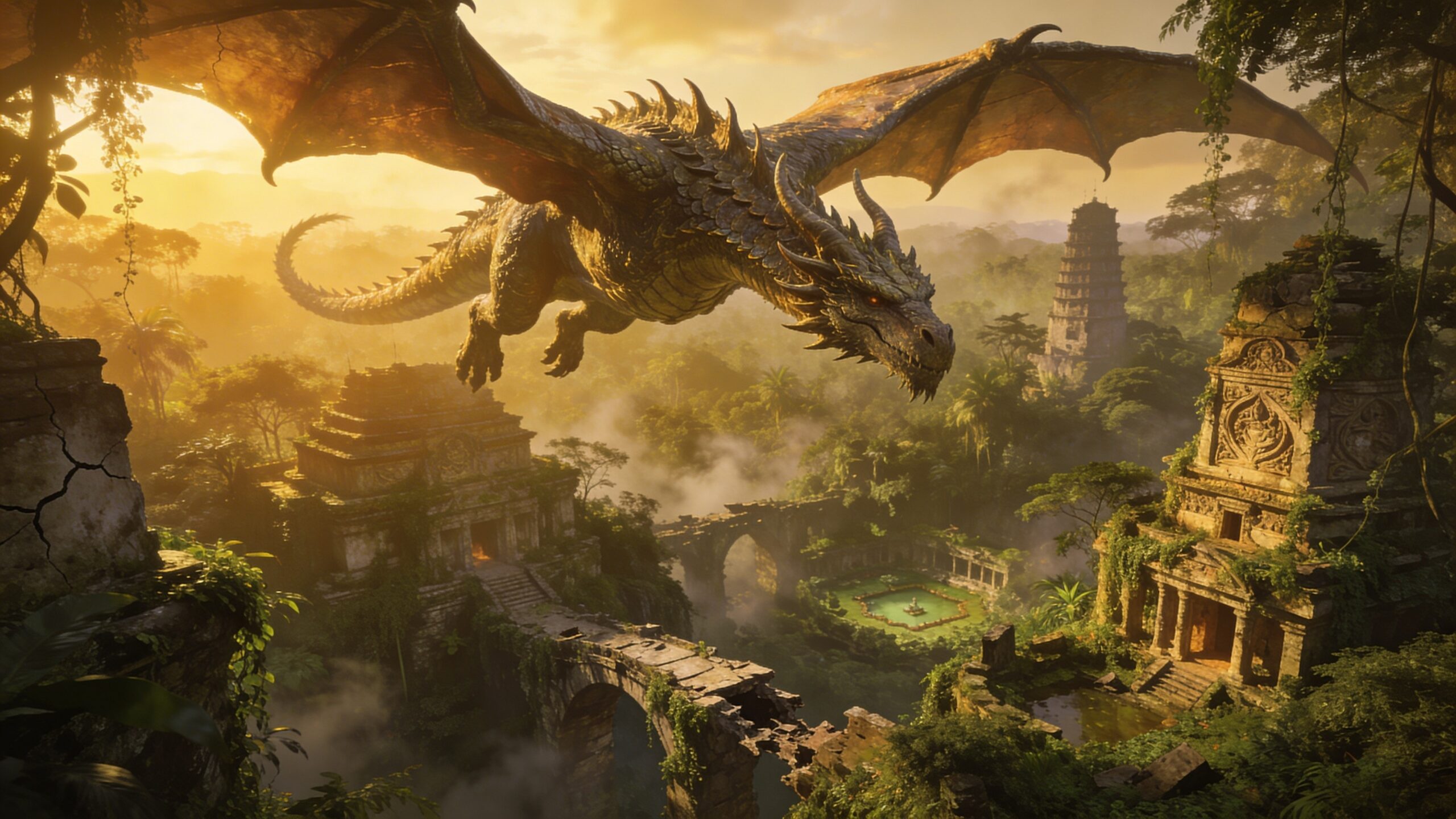
Among all legendary protectors, dragons may be the most enduring. In many cultures, dragons are not only destroyers. They are keepers of thresholds, guardians of treasure, watchers of sacred mountains, and rulers of hidden places. When paired with ruins, the dragon becomes more than a beast. It becomes a living lock on the door of the past. In European legend, dragons often guard hoards in caves, broken fortresses, or lost strongholds. These stories blend naturally with the image of buried ruins. A collapsed citadel in the hills feels like the kind of place where a dragon might wait beneath shattered towers, protecting gold, relics, or cursed knowledge. The dragon in these stories is both obstacle and warning. Its presence says that the treasure is not meant for ordinary hands.
In Asian traditions, dragon-like beings can play a different role. Rather than simple monsters, they may be sacred powers tied to water, storms, rivers, or the spiritual balance of the land. When such beings are connected to hidden temples or ancient ruins, they become guardians of harmony and sacred order. To disturb the ruin is not merely to risk attack. It is to disrupt a relationship between the land, the past, and the unseen. This makes dragons especially powerful in stories about hidden ruins around the world. They stand at the border between greed and reverence. Those who enter ruins seeking wisdom may pass with humility. Those who enter seeking conquest often awaken something terrible.
Serpent Guardians Beneath Stone and Sand
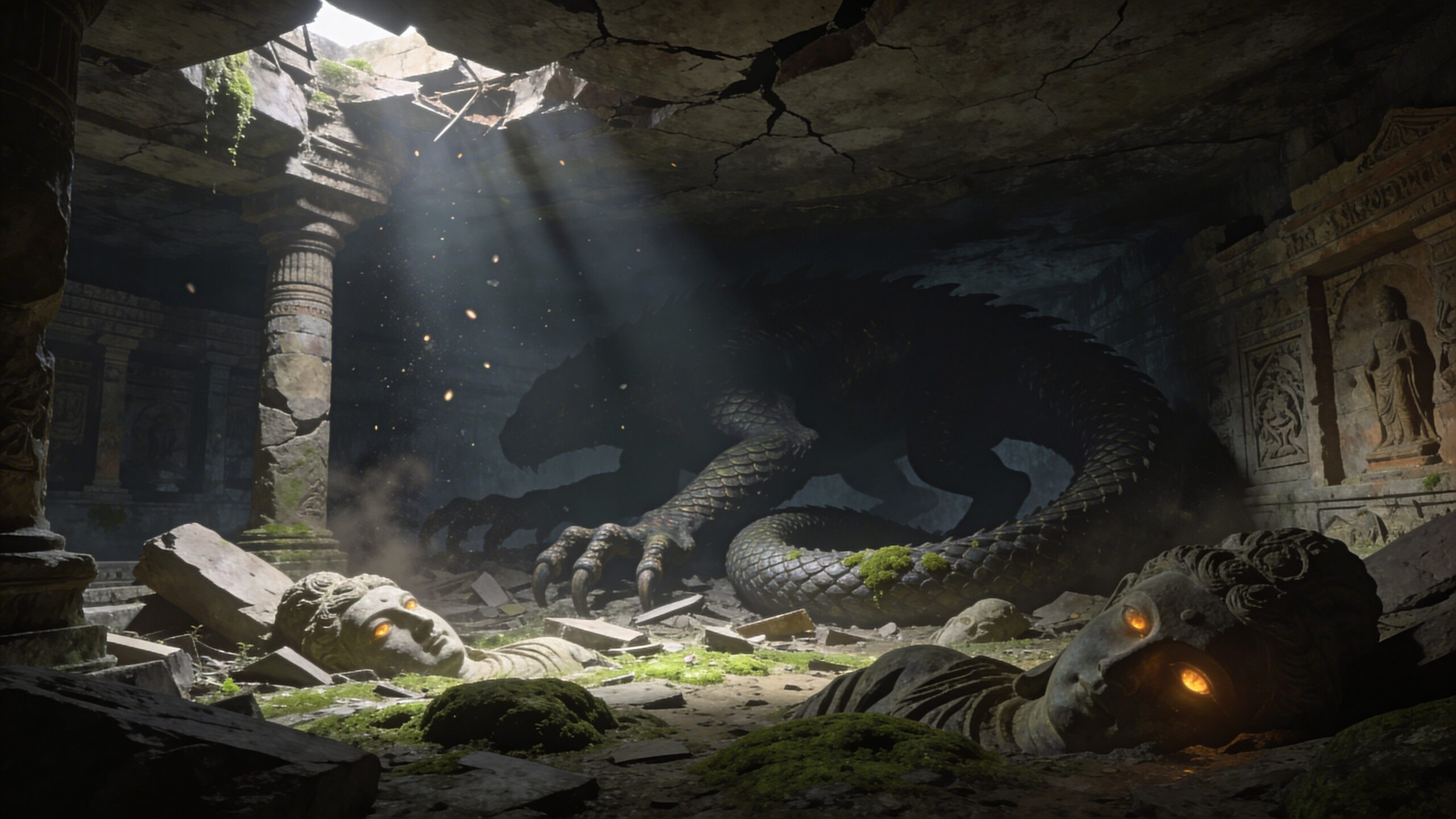
If dragons rule the sky and mountain in myth, serpents rule the deep places. Giant serpents, feathered serpents, sea serpents, and underworld serpent gods appear across cultures as ancient beings connected to hidden power. They are among the most common creatures said to protect ruins because ruins so often include tunnels, chambers, wells, stairways, and buried passage networks that feel serpent-made even when carved by human hands.
A serpent guardian is especially effective in legend because it belongs to movement, secrecy, and patience. It can vanish into cracks. It can wait unseen beneath stone floors. It can be associated with rivers under cities, underground springs beneath temples, or ceremonial shafts descending into the earth. In lore tied to lost civilizations, serpent guardians are often connected to forbidden knowledge, sacred kingship, weather, fertility, and cosmic power.
Some stories imagine the serpent as a divine protector watching over an entire ruin complex. Others frame it as a creature sealed below a temple to prevent catastrophe. In either form, the serpent becomes inseparable from the site. The ruin is not just where it lives. The ruin is part of its body of meaning. This is why serpent legends are so compelling in global ruin mythology. They combine beauty, terror, symbolism, and the oldest human instincts about what may be waiting below the surface.
Sacred Beasts That Guard Temples and Tombs
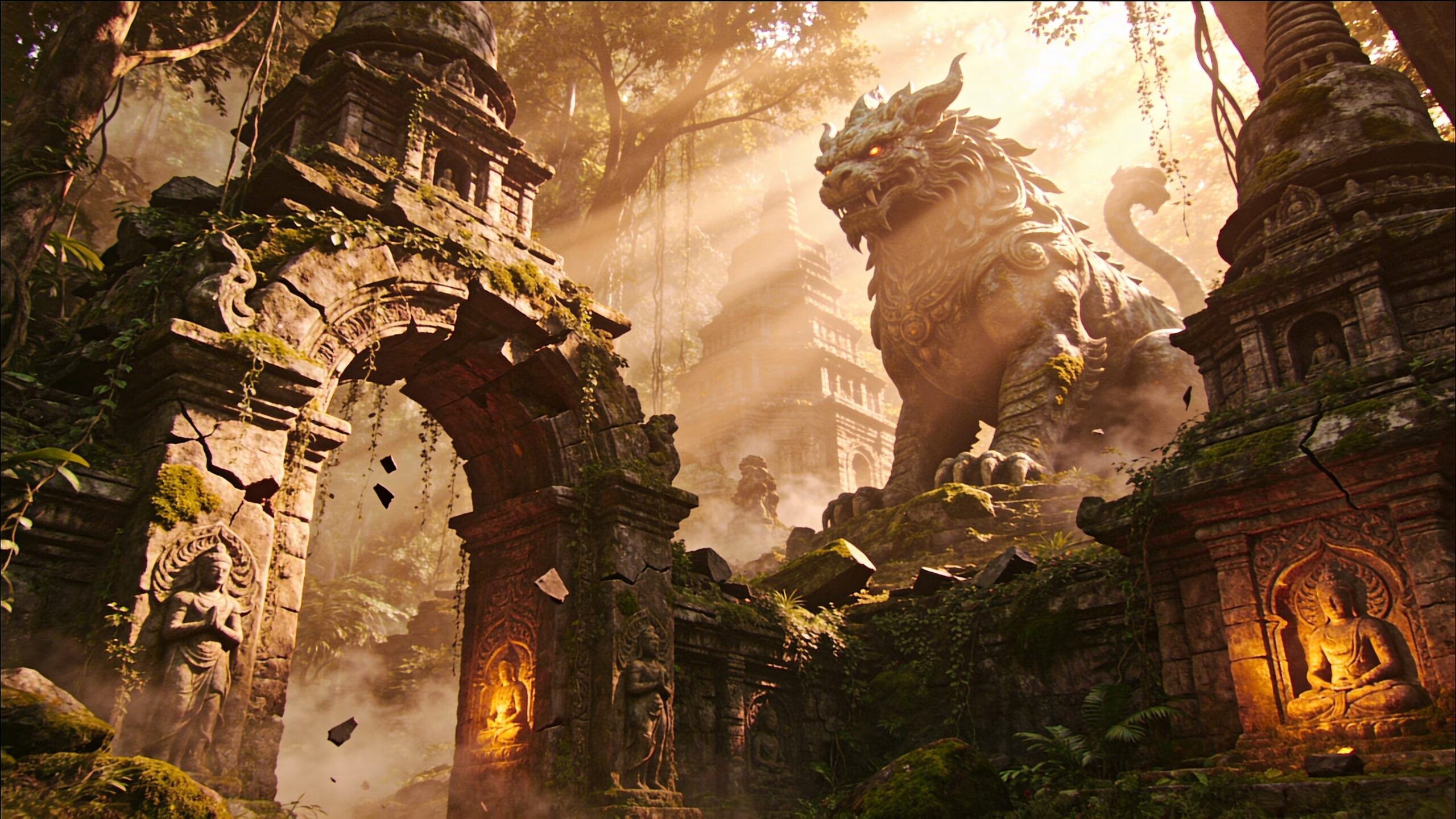
Not every guardian of a hidden ruin is monstrous in the simplest sense. Many are sacred beasts, noble and fearsome rather than purely evil. Lions, bulls, eagles, wolves, feline hybrids, and composite beings appear throughout world mythology as protectors of gates and holy places. When linked to forgotten ruins, these creatures become symbols of enduring authority. A ruined temple guarded by a lion-like spirit feels different from one watched by a serpent. The lion guardian suggests royalty, sunlight, judgment, and visible power. A bull guardian suggests force, stability, sacrifice, and ancient strength. An eagle or winged beast evokes divine oversight and elevated vision. These associations matter because ruins are not all the same. Some protect tombs. Some hide relics. Some mark pilgrimage sites. The nature of the guardian reflects the nature of the place.
In many stories, sacred beasts test intention. They do not simply kill any traveler who approaches. They reveal character. The selfish, arrogant, and violent are turned back or destroyed. The worthy, reverent, or chosen may be allowed to pass. This makes the creature more than a monster. It becomes an ancient moral force. That idea remains powerful in modern storytelling because it transforms ruins into places of judgment. The question is not only what is hidden there. The question is whether anyone alive deserves to find it.
Shadow Guardians and the Fear of the Unseen
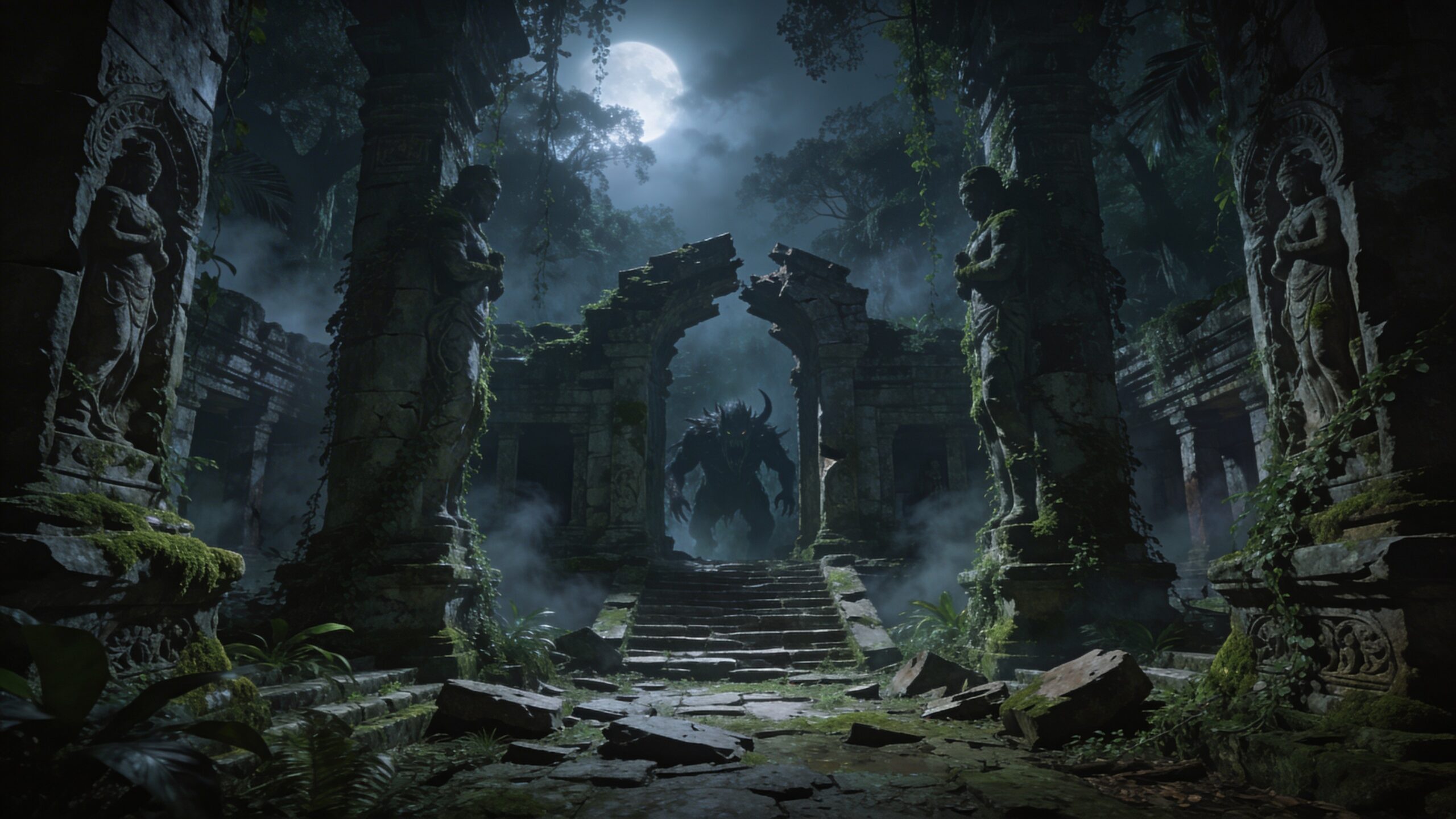
Some of the most unsettling ruin legends do not feature giant visible beasts at all. Instead, they speak of shadow guardians. These are creatures or spirits that are barely seen and never fully understood. They move between columns, appear at the edge of torchlight, or seem to emerge from the architecture itself. In stories about hidden ruins, shadow guardians often feel more frightening than dragons because they cannot be clearly defined.
A shadow guardian may be the spirit of the ruin’s builders, a curse given form, or a creature that has adapted to underground darkness for centuries. It may take different shapes depending on who sees it. One traveler sees glowing eyes. Another hears claws on stone. A third finds footprints where no body appears. This uncertainty allows the ruin to remain mysterious. The guardian is not just protecting the site. It is protecting the site from being fully explained.
Shadow creatures are especially common in tales of underground ruins, catacombs, sealed sanctuaries, and buried cities rediscovered after long absence. They fit places where light is limited and perception is unreliable. A gust of air feels alive. An echo sounds like breathing. A movement in darkness becomes proof. From a storytelling perspective, shadow guardians are powerful because they turn the ruin itself into a participant. Every corridor becomes suspicious. Every chamber becomes a trap of silence and fear. The hidden ruin is no longer a destination. It becomes a living maze with a will.
Why Ancient Cultures Imagined Guardian Creatures
The idea of creatures protecting hidden ruins did not come from nowhere. It reflects how ancient cultures viewed sacred architecture. Temples were not ordinary buildings. Tombs were not simple storage chambers. Ceremonial sites connected the living to gods, ancestors, kings, and cosmic forces. To violate these places was not only disrespectful. It was dangerous. Guardian creatures made that danger visible. They expressed the belief that some knowledge should remain hidden, some relics should remain untouched, and some locations should only be entered with proper preparation. In practical terms, these myths discouraged theft and desecration. In spiritual terms, they affirmed that sacred places retained power even after the civilization that built them had faded.
The creatures themselves also reflected local values. A mountain culture might imagine a cliff guardian. A river civilization might imagine a serpent or crocodilian protector. A desert civilization might envision a lion, jackal, or sand-buried beast. Over time, these guardians became part of the identity of the ruins they protected. That is why legendary creatures linked to ruins feel so specific and memorable. They are not generic monsters dropped into old places. They emerge from the history, landscape, and spiritual imagination of the cultures that first told the stories.
Hidden Ruins in the Modern Imagination
Modern audiences remain fascinated by legendary creatures protecting hidden ruins because the idea still feels possible in an imaginative sense. Even today, new chambers are discovered, buried cities are mapped, and forgotten sites emerge from forests, deserts, and mountains. Every real discovery feeds the sense that much remains concealed.
Adventure fiction, fantasy worlds, horror tales, and cryptid culture all borrow from this old pattern. A ruin is more exciting when it is watched. A treasure is more meaningful when something ancient has chosen to defend it. A lost civilization feels more alive when its final protectors still remain.
There is also a deeper emotional pull. Hidden ruins symbolize what humanity has forgotten. Legendary guardians symbolize the forces that prevent easy recovery. Together, they create a powerful story about limits. Not everything can be claimed. Not every mystery can be solved without cost. Some places demand reverence before revelation. That message feels especially relevant now, in an age that often assumes everything can be found, scanned, and explained. Ruin guardians resist that assumption. They remind us that wonder depends on boundaries.
The Timeless Power of Protected Places
At the heart of these stories is a simple but enduring truth: places matter more when they are protected. A hidden ruin guarded by nothing is just abandoned architecture. A hidden ruin guarded by a legendary creature becomes a threshold between worlds. That creature may be a dragon coiled beneath a forgotten city, a serpent gliding through buried water channels, a sacred lion watching a temple gate, or a shadow-being born from the silence of underground halls. In every case, the guardian changes the meaning of the ruin. It tells us that the past is not dead. It is defended.
This is why stories of legendary creatures that protect hidden ruins around the world continue to captivate readers. They combine history, danger, wonder, and spiritual depth in a way few other themes can match. They turn old stones into living mysteries and make remote places feel close to the edge of revelation. Ruins endure because stone lasts. Legends endure because imagination lasts longer. When the two meet, the result is unforgettable: a hidden place, a forbidden threshold, and something ancient still standing watch.