Why Creature Size Matters More Than Most Designers Think
Creature design often begins with a silhouette, a mood, or a striking visual idea, but size is the quiet decision that makes the entire concept believable. A creature’s scale determines how it occupies space, how it moves through the world, how threatening or graceful it feels, and how audiences emotionally respond to it. The same basic anatomy can suggest a nimble scavenger, an apex predator, or a mythic giant depending on how large the creature is imagined to be. That is why size is never just a measurement. It is a narrative choice, a worldbuilding choice, and a realism choice all at once. When scale is handled well, the creature immediately feels like it belongs somewhere. It seems adapted to an environment, shaped by its biology, and rooted in the rules of its world. When scale is handled poorly, even beautiful creature art can feel strangely artificial. The viewer may not be able to explain why, but something seems off. The creature might look too light for its mass, too fragile for its height, or too oversized for the terrain around it. Believability depends on these relationships, and that is why understanding size is one of the most valuable skills in creature design.
A: Because size affects realism, movement, mood, worldbuilding, and how viewers emotionally respond.
A: Size is the creature’s actual dimensions, while scale is how large it feels relative to other things.
A: They usually lack structural support, weight cues, or believable interaction with the environment.
A: Yes, especially when design emphasizes speed, intelligence, swarm behavior, or stealth.
A: Add familiar references like humans, doors, vehicles, trees, buildings, or footprints.
A: Absolutely, because bad proportions can break believability even if the scale is correct.
A: Not perfectly, but biological logic makes imaginative designs feel stronger and more convincing.
A: Movement proves whether the creature’s body truly feels suited to its size and mass.
A: The setting helps explain how the creature lives, moves, hides, hunts, and dominates space.
A: Treating size as a visual gimmick instead of something that should influence the whole design.
Size, Scale, and Proportion Are Not the Same Thing
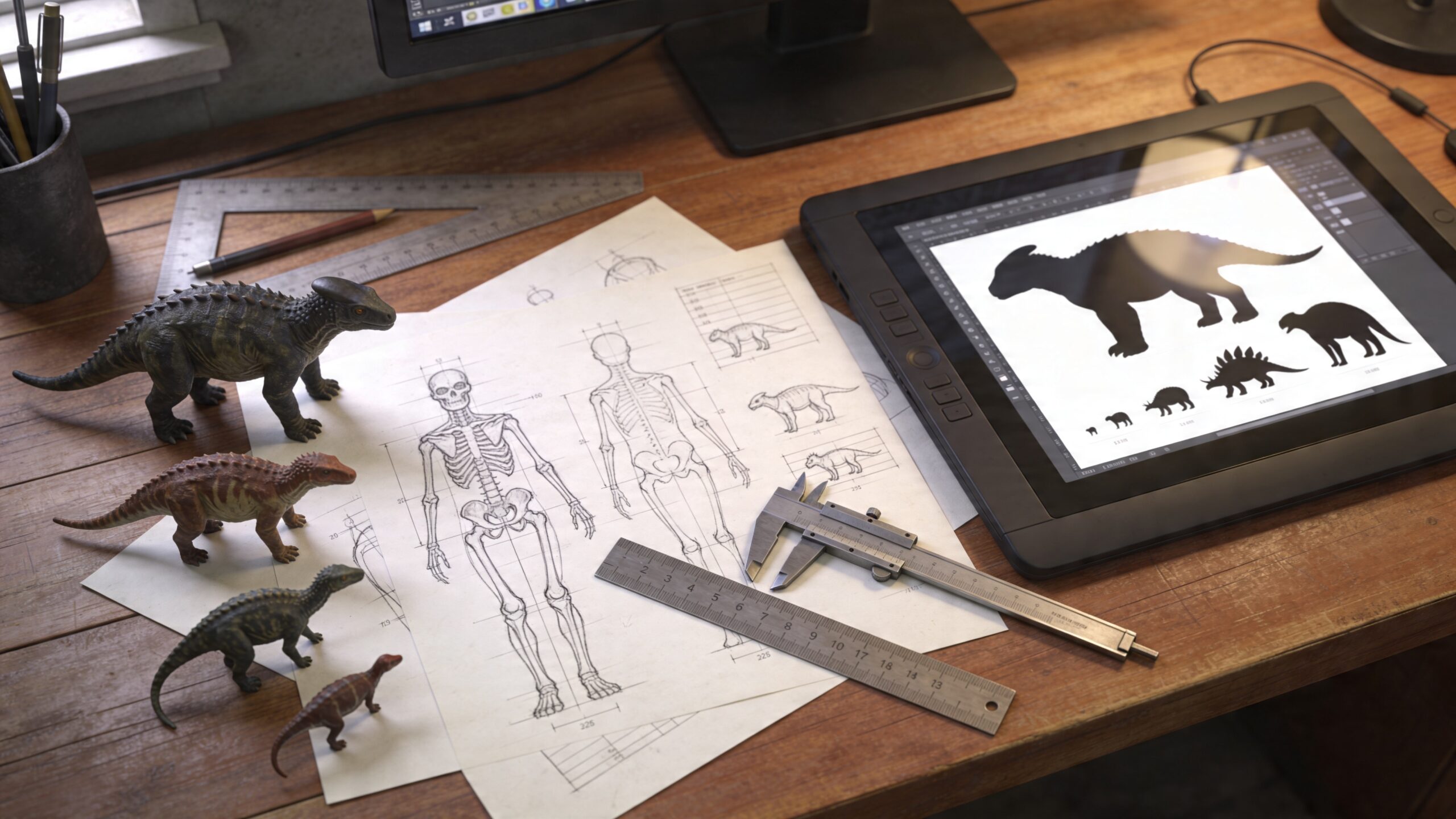
Many people use size, scale, and proportion as if they mean exactly the same thing, but in creature design they do different jobs. Size refers to how big the creature actually is. Scale is relational. It describes how big the creature feels compared with humans, buildings, forests, vehicles, or anything else around it. Proportion deals with internal relationships inside the creature itself, such as leg length compared with torso length, head size compared with shoulder width, or wing span compared with total body mass.
These distinctions matter because a creature can be large without feeling large, or small without feeling weak. A medium-sized animal can look enormous in a cramped tunnel, while a giant beast can appear less impressive in an open desert unless there are strong environmental cues to frame it. A creature can also have unusual proportions and still feel believable if those proportions support its behavior and function. Once designers separate these ideas, they can make much more precise creative decisions. Instead of vaguely asking whether a creature “looks right,” they can ask whether its size fits the world, whether its scale reads clearly in a scene, and whether its proportions support movement and anatomy.
Believability Begins With the Environment
A creature does not exist in isolation. It exists in a landscape, an ecosystem, a built environment, or a fantasy realm with its own rules. That setting is one of the biggest clues for deciding how large the creature should be. Forest creatures, cave-dwelling creatures, ocean titans, desert runners, and city-haunting monsters all inherit different scale logic from their surroundings. A creature that lives in dense brush or tangled roots may need to be compact, flexible, and low to the ground. A creature built for open plains may grow taller, longer-legged, and more visible across great distances. Environment also controls how the audience experiences size. A creature standing beside a doorway, a bridge, or a line of trees gains immediate scale context. The viewer no longer has to guess. In design, that clarity is powerful. It lets the world itself explain the creature. A giant creature should feel like it changes the space around it. A tiny creature should feel like the environment looms over it. The most convincing designs use the environment not as a background decoration, but as evidence. Scale becomes believable when the setting confirms it again and again.
Real-World Biology Offers a Powerful Design Framework
Even the most imaginative creature designs become stronger when they borrow logic from biology. In real animals, size affects everything. It affects how bones handle weight, how muscles generate movement, how quickly heat is lost, how much food is needed, and how energy is spent. Small animals can move with startling speed and sudden changes in direction because their bodies deal with mass differently. Large animals carry enormous weight, so their bodies must be built to support it. This is why elephants do not move like cats and why insects do not move like rhinos.
For creature designers, biology does not need to act like a cage, but it should act like a foundation. If a creature is made very large, its feet, joints, torso, and posture should reflect that load. If it is tiny, its movements and survival traits should reflect its vulnerability and agility. Believability comes from respecting consequences. The more a designer understands the physical implications of scale, the more confidently they can bend those rules when designing fantasy or science fiction creatures. A believable giant does not need to be realistic in every scientific detail, but it should look like its body has been shaped by the challenge of being giant.
Giant Creatures Need More Than Bigger Bodies
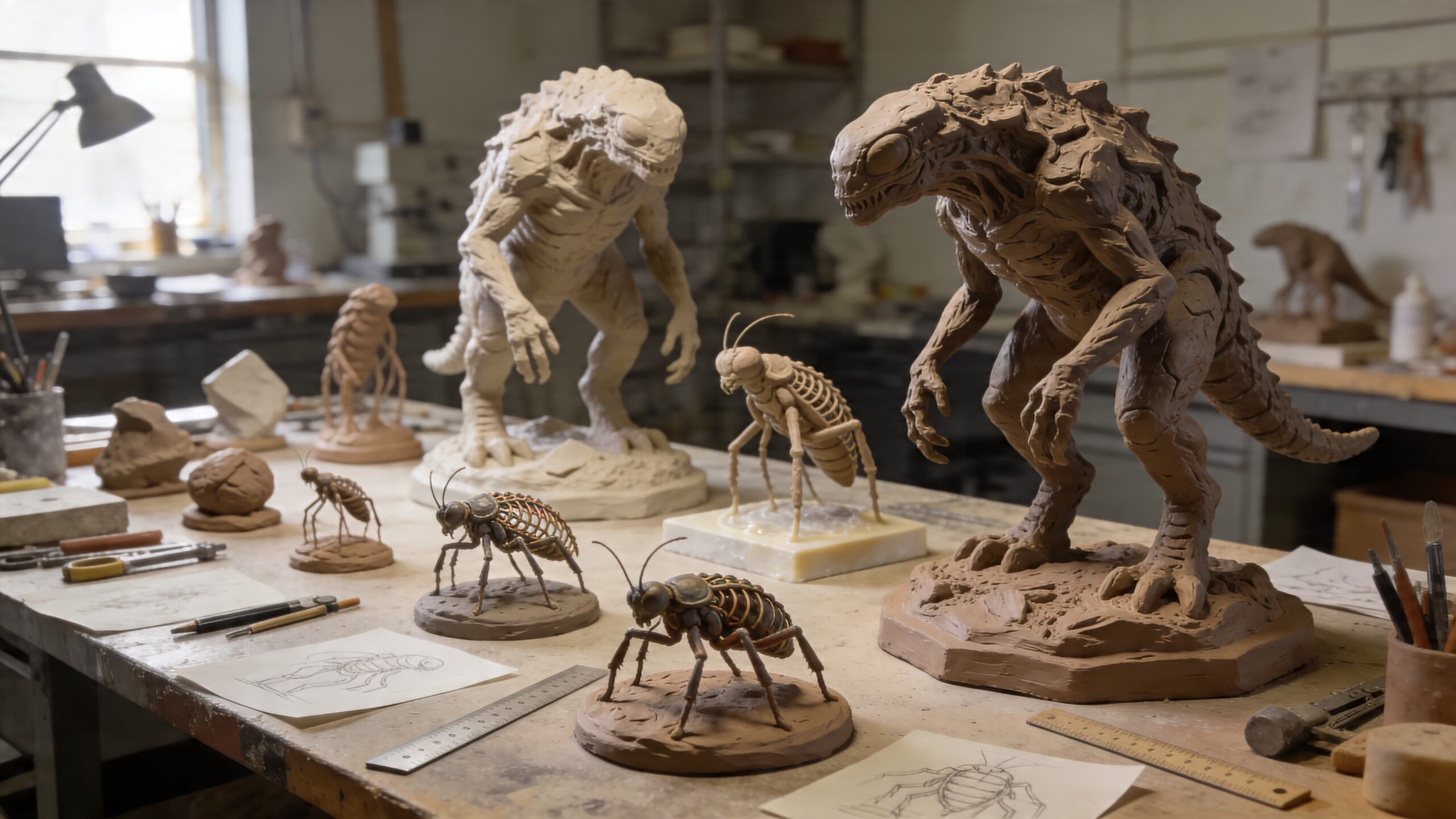
One of the most common mistakes in creature design is taking a smaller animal idea and simply enlarging it. In practice, true size changes a creature’s entire physical language. A giant creature should not feel like a normal creature viewed through a zoom lens. It should feel like a being whose every movement carries force, delay, inertia, and consequence. Its posture may be broader. Its legs may be thicker. Its neck may need more structural support. Its pace may be slower, but every step may matter more. The feeling of mass is just as important as the measurement itself. A towering creature becomes believable when the viewer senses weight before they consciously calculate scale. Ground compression, dust displacement, swaying vegetation, cracked stone, echoing footsteps, and slow shifts of balance all help sell that illusion. Giant creatures also benefit from design restraint. Overloading them with delicate details can sometimes make them feel toy-like. Broad forms, readable anatomy, and clear structural logic often create a more convincing sense of enormity. Big creatures need visual gravity, not just bigger numbers.
Small Creatures Can Still Feel Dangerous and Important
Small creature design is often underestimated because many people equate importance with size. In storytelling and visual design, that is rarely true. Small creatures can feel unnerving, intelligent, fast, invasive, or impossible to control. Their impact usually comes not from raw power but from behavior, contrast, and strategic use of space. A tiny predator slipping through ruins, walls, or ventilation shafts can create tension that a giant monster cannot. Scale shapes fear in different ways.
Believable small creatures often rely on sharper rhythms of motion, tighter body plans, and more immediate interaction with surfaces and obstacles. Their design can emphasize adaptability, density, or unusual survival mechanisms. Small size can also heighten detail in interesting ways. Fine claws, translucent skin, clustered eyes, folding limbs, or insect-like articulation can make a tiny creature visually memorable. To make a small creature feel significant, designers usually do not need to make it more massive. They need to make it more specific. The smaller the form, the more carefully its behavior and anatomy should communicate why it matters.
Proportion Creates Function, Mood, and Personality
Proportion is one of the most expressive tools in creature design because it quietly shapes how the audience reads intention. A creature with a deep chest and short neck may feel durable and forceful. A creature with long limbs and a narrow torso may feel elegant, nervous, or predatory. An oversized head can suggest youth, intelligence, or stylization, while undersized eyes can create distance and menace. These decisions influence believability because they suggest purpose. Good proportions make the viewer feel that the creature’s body belongs to its lifestyle. Climbers need different relationships between limb length and body mass than swimmers or burrowers. Ambush predators carry tension differently than migratory herbivores. Even in stylized work, internal consistency matters. If one body part is exaggerated, the rest of the design should respond in a way that feels intentional. That does not mean every creature must be realistic. It means the design should explain itself. Proportion is most effective when it turns appearance into evidence.
Movement Is the Proof of Scale
A creature can look impressive in a still image, but motion is where scale is truly tested. The way a creature accelerates, turns, lands, crouches, climbs, or simply shifts its weight reveals whether its size makes sense. Large creatures should usually carry momentum. Their movements may begin slowly and finish with force. Smaller creatures often feel reactive, rapid, and elastic. If motion contradicts scale, the illusion breaks quickly.
Designers who think about movement early tend to create more believable creatures. Joint placement, balance points, limb range, spinal flexibility, and tail function all become more convincing when considered in relation to size. A giant beast with thin, delicate ankles may feel unstable unless the design intentionally explains that fragility. A tiny creature with heavy, lumbering movement may need a special body structure or environmental reason to justify it. Even when designing for still artwork, imagined motion strengthens anatomy. The viewer should be able to sense not only how the creature stands, but how it lives.
Scale Shapes Emotion and Storytelling
One of the most powerful aspects of creature size is how directly it influences feeling. A giant creature can inspire awe, dread, reverence, or helplessness. A small creature can create unease, curiosity, pity, or paranoia. The physical size of a creature becomes emotional size in the mind of the audience. That makes scale a storytelling device, not just a design parameter. If the goal is wonder, a designer may use immense vertical scale, long silhouettes, and environmental framing that makes the creature seem ancient or world-defining. If the goal is fear, the creature’s size may interact with confinement, speed, or unpredictability. Not every terrifying creature is massive, and not every majestic creature needs to dominate the horizon. What matters is how the size supports the intended emotional experience. Believability improves when the design, environment, and narrative mood all point in the same direction.
Human Reference Makes Scale Instantly Legible
Humans remain one of the most useful tools in creature design because people intuitively understand human scale. The moment a creature stands beside a person, a doorway, a car, or a familiar object, the audience gains a reliable sense of size. That reference creates clarity, and clarity helps believability. Without reference, viewers can misread scale completely, especially in empty or abstract environments.
This does not mean every creature design must literally include a human figure, but it should often include human-readable elements. Footprints in mud, broken fences, bent streetlights, snapped boats, crushed stairways, or worn tunnels all communicate how large or small the creature is. These clues are especially important in concept art and visual development, where the image must explain its own logic quickly. Good scale communication removes ambiguity without killing mystery. The viewer can still wonder what the creature is while understanding how large it must be.
Perspective, Composition, and Visual Framing Sell the Illusion
Scale is not only designed through anatomy. It is also designed through presentation. Perspective, camera angle, lighting, and composition strongly affect how large a creature feels. A low angle can give a creature dominance and monumentality. A high angle can diminish it or reveal vulnerability. Objects in the foreground can frame distance and help the viewer feel depth. Layers of atmosphere can make a large creature feel truly far-reaching instead of flat and cut out. Visual framing is especially important because many creatures are never experienced as neutral diagrams. They are seen in scenes, action beats, posters, cinematic shots, or key art. In those contexts, scale is a performance. A creature standing in open space with no context can feel less convincing than a creature partially obscured by architecture, terrain, fog, or vegetation. Believability is often created by implication. The viewer believes the scale because everything around the creature behaves as though that scale is real.
Common Scale Mistakes That Break the Illusion
Many scale problems come from inconsistency rather than lack of imagination. A creature may look huge in one view and oddly manageable in another. Its limbs may suggest heavy mass, while its posture suggests effortless agility. Its head may be designed for one scale and its torso for another. These contradictions create friction. The audience may not articulate the problem, but they feel it immediately.
Another common mistake is overdesigning without considering function. Endless spikes, thin appendages, decorative plating, or layered anatomy can look exciting in isolation yet weaken the sense of structural realism. Some designers also forget that environments must react to size. If a giant creature leaves no impact on the world, its scale loses credibility. If a tiny creature moves through the world without any special adaptation, its smallness feels cosmetic. Scale should affect everything. When it does not, believability fades.
Designing for Realism Without Losing Imagination
One of the most exciting things about creature design is that it allows designers to move beyond ordinary biology while still creating convincing forms. Realism and imagination are not enemies. In fact, imagination usually becomes more compelling when it is supported by logic. A dragon can feel more believable if its body structure suggests how it launches, lands, and carries its weight. A colossal sea creature becomes more persuasive when its shape reflects the pressure, darkness, and scale of the deep ocean. A miniature scavenger becomes more interesting when its body suggests speed, concealment, and efficient feeding. The goal is not to make every creature scientifically perfect. The goal is to create enough coherence that the audience accepts the creature on its own terms. Once a design earns that trust, imaginative choices feel more powerful rather than less. The viewer believes because the creature seems designed from the inside out. Scale, in that sense, becomes part of the creature’s identity. It is not an added statistic. It is one of the reasons the creature feels alive.
Believability Lives in the Relationship Between Body and World
Creature size is one of the deepest forces in design because it shapes anatomy, movement, emotion, and worldbuilding all at once. A believable creature is not simply well drawn. It is scaled in a way that makes sense for its body, its environment, its behavior, and its narrative role. Whether the design is a towering giant, a lean predator, or a tiny and unsettling crawler, size helps determine how the audience understands it before it ever moves or makes a sound.
The best creature designers treat scale as a living relationship rather than a measurement on a chart. They think about what the creature weighs, how it travels, what spaces it occupies, what it hunts, what threatens it, and how the world around it confirms its existence. That is why scale shapes believability so strongly. When size feels right, everything else becomes easier to believe. The creature no longer feels like an illustration of an idea. It feels like something that could truly exist in its world.