The Dream Before the Creature
Movie creatures do not begin with code, clay, or costumes. They begin with a question. What should this being make the audience feel? Fear, wonder, sympathy, awe, discomfort, curiosity, or even love? Before a creature has teeth, scales, fur, glowing eyes, or a voice, it has a narrative purpose. That purpose shapes every decision that follows, because the most memorable creatures in film are never just visual effects. They are storytelling tools with presence, personality, and meaning. In the earliest stages of development, filmmakers decide how the creature functions inside the story world. Is it a predator, a protector, an ancient godlike force, or a misunderstood survivor? Is it meant to dominate a scene with sheer power, or quietly disturb viewers through subtle, uncanny behavior? These questions matter because creature creation is not just about inventing a cool design. It is about building something that belongs in the emotional logic of the film. The audience may first notice the claws or the skin texture, but what makes a creature unforgettable is how completely it feels tied to the world around it.
A: No. Many productions use a mix of CGI, puppetry, prosthetics, animatronics, and suits.
A: The design usually starts early, long before final effects production begins.
A: Believability comes from strong anatomy, convincing movement, good lighting, and consistent behavior.
A: Often yes, especially in motion capture, suit performance, stunt work, or puppetry-assisted scenes.
A: Animal reference helps designers build realistic anatomy, locomotion, and instinctive behavior.
A: Rigging creates the digital skeleton and controls that allow animators to move the creature.
A: Extremely important. Sound gives creatures presence, personality, and emotional impact.
A: Yes. Practical effects remain powerful because they provide physical realism on set.
A: Careful pacing, strong framing, sound buildup, and a design that rewards the anticipation.
A: Making every element, from design to movement to lighting, feel like one living whole.
Story First, Design Second
Once the story team understands the creature’s role, the design process begins. Writers, directors, production designers, and creature artists work together to define the tone. A fantasy adventure may call for creatures that feel majestic and magical, while a horror film may need forms that are distorted, threatening, and unpredictable. Science fiction may push designs toward biology, engineering, or alien logic. Every genre changes the creative target.
At this stage, artists begin building visual language. They think in silhouettes, posture, scale, and mood. A broad-shouldered creature with a hunched spine suggests strength and menace. Long limbs and an unnatural gait can make something feel eerie before it ever attacks. Delicate features, intelligent eyes, or graceful motion can create empathy, even in a nonhuman form. Designers are not only sketching anatomy. They are sketching reaction. They are asking what the audience should instantly feel the moment the creature appears.
From Rough Sketches to Visual Identity
Concept artists are usually the first people to give the creature a visible form. Their early work is exploratory rather than final. They may create dozens of versions that play with head shapes, bone structures, skin surfaces, limb proportions, and facial features. Some versions may lean more animalistic, while others may feel more humanoid or mythic. These sketches are fast, imaginative, and often wildly varied, because the goal is not perfection. The goal is discovery. As the design narrows, the creature begins to take on a clearer identity. The team decides what features are essential and which ones distract from the core idea. A certain jawline may make the face more expressive. A longer neck may improve the silhouette. A layer of bioluminescent skin patterns may feel beautiful, but if it clashes with the tone of the film, it might be removed. This is where design becomes disciplined. The creature starts evolving from possibility into intention.
Borrowing From Nature to Create the Impossible
Even the most fantastical movie creatures usually borrow something from the real world. Artists study reptiles, birds, insects, mammals, deep-sea organisms, and human anatomy to ground their creations in recognizable logic. This is one of the secrets behind believable creature design. When viewers sense echoes of real biology, the impossible begins to feel plausible.
A creature may have the shoulder structure of a big cat, the skin folds of an elephant, the eye placement of a bird of prey, and the defensive movement patterns of a lizard. These references help create anatomical credibility. The audience may never consciously identify every inspiration, but they respond to the realism beneath the invention. Nature gives artists a library of forms, mechanics, and survival strategies. Film creature design transforms that library into something original.
Building Anatomy That Can Actually Move
Once the visual identity is approved, the creature needs a functioning body plan. This is where design becomes technical. Artists and modelers start thinking like engineers and biologists. How does this being stand? Where is its weight centered? How would its joints bend? If it runs, jumps, flies, or crawls, what structures make that possible? A creature that looks impressive in a still image can fall apart instantly if its anatomy makes movement feel impossible. This stage is crucial because motion sells life. A heavy creature must feel heavy. A nimble creature must look balanced and efficient. A giant screen monster cannot move like it weighs nothing, and a fragile insect-like being cannot stomp around like a tank without breaking the illusion. Muscle placement, limb length, spinal flexibility, and bone logic all influence how animators and effects artists will eventually bring the creature to the screen. Good anatomy does not limit creativity. It gives creativity a believable framework.
Sculpting the Creature Into Form
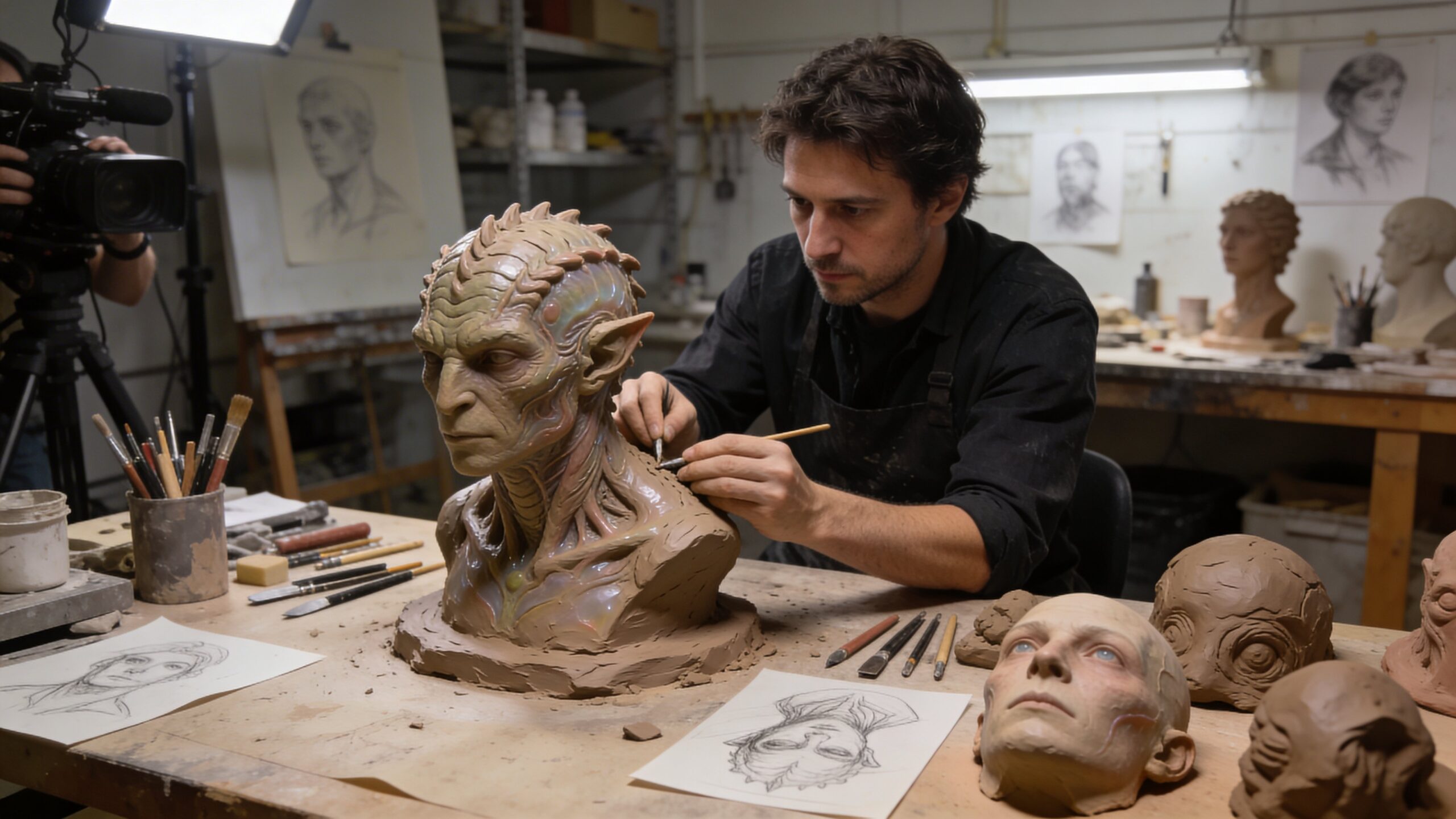
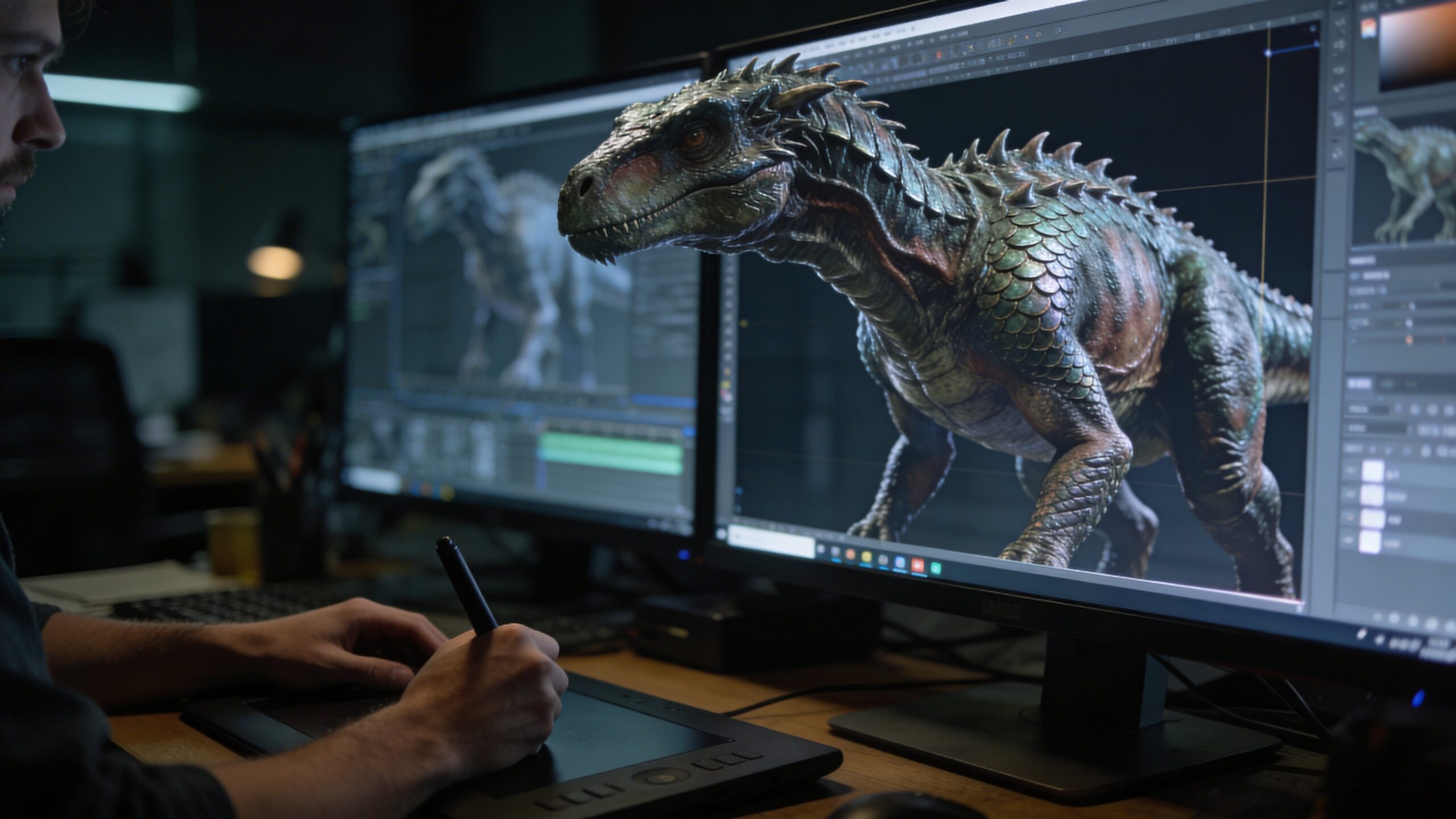
After the design has matured, it moves into three-dimensional development. Depending on the production, this can happen through digital sculpting, physical sculpting, or both. Digital artists use advanced software to build the creature in high detail, shaping every ridge, wrinkle, tendon, horn, and fold. Physical effects teams may sculpt maquettes in clay or other materials to study the form in real space.
This stage is where the creature stops being an illustration and starts becoming a body. Volume matters now. Surface detail matters now. The way light hits a cheekbone, the thickness of a claw, the tension in the shoulders, and the asymmetry of the face all become part of the creature’s identity. The smallest details can change how alive the design feels. A perfectly symmetrical face may look artificial, while subtle irregularities can make the creature feel like a real organism rather than a digital model.
Choosing Practical Effects, CGI, or a Hybrid Approach
One of the biggest decisions in creature filmmaking is how the creature will physically exist in the production. Some creatures are fully computer-generated. Some are built as animatronics, prosthetics, puppets, or suits. Many of the best modern creatures use a hybrid approach that combines practical effects with digital enhancement. The choice depends on budget, creative goals, the type of performance needed, and how the creature interacts with actors and environments. Practical effects offer a tangible presence. Actors can see and react to something real, and cinematographers can light a physical surface naturally. Costumes and prosthetics can create astonishing realism, especially for close-up work. Animatronics can add blinking eyes, breathing, subtle facial movement, or complex jaw mechanics. CGI, on the other hand, allows filmmakers to create impossible scale, extreme agility, nonhuman transformations, and detailed creatures that would be impossible to build physically. The most convincing results often come from blending both methods so the creature feels tactile and cinematic at the same time.
Performance: The Soul of the Creature
A creature can look spectacular and still feel empty if there is no strong performance behind it. This is why performers, stunt artists, puppeteers, and motion capture actors are so important in creature filmmaking. They provide the rhythm, intent, emotion, and unpredictability that make creatures feel sentient. Even creatures with no dialogue require acting. Their pauses, head turns, breaths, reactions, and focus all communicate thought.
For motion capture creatures, performers often build entire physical vocabularies based on the creature’s design and psychology. They may combine human technique with animal study, inventing a new movement language that feels specific to that being. For practical creatures, puppeteers and suit performers work with similar care, finding ways to make restricted mechanical forms feel expressive. The performance does not replace the design. It activates it. It gives the creature inner life.
Rigging and Animation: Teaching the Body to Move
For digital creatures, the next stage is rigging. This means creating a virtual skeleton and control system that animators can use to move the creature convincingly. Rigging is technical, but it has enormous creative consequences. A poorly rigged creature will never move naturally, no matter how good the design is. A well-rigged creature gives animators flexibility, nuance, and control over everything from posture to facial expression. Animation then builds the performance shot by shot. Animators study reference footage, motion capture data, and real-world movement to find the right combination of realism and dramatic clarity. They adjust timing, spacing, weight shifts, eye focus, body tension, and secondary motion. Tails, ears, loose skin, and muscle jiggle can all add credibility. Great creature animation is not just about motion. It is about intention. The audience should feel that the creature is making choices, reacting to its world, and behaving with purpose.
Surface Detail: Skin, Fur, Scales, and Texture
A creature’s surface is one of the main things that determines whether it looks expensive, believable, and cinematic. Texture artists develop the skin language of the creature with extraordinary care. They decide where scars appear, how skin stretches over bone, how scales catch light, how fur clumps, how feathers overlap, and how wetness, dirt, age, or damage affect the final look. These details add history. They make the creature feel lived in.
Texture also supports storytelling. A battle-worn creature may have chipped horns and scarred hide. A deep-ocean predator may have translucent skin and bioluminescent features. A forest creature may have muddy fur, broken claws, and layers of environmental debris. These are not just decorative details. They tell the audience where the creature has been and how it survives. Surface design is often where fantasy becomes believable.
Lighting, Rendering, and Making the Creature Belong
Even a beautifully animated creature can fail if it does not sit naturally inside the shot. Lighting and rendering are what help integrate it into the world of the film. Visual effects teams study the live-action scene carefully, matching the direction, color, intensity, and softness of the real light on set. Reflections, shadows, atmospheric haze, and environmental bounce light all matter. A creature must look like it exists under the same sun, moon, firelight, or fluorescent glow as everything around it. Rendering then turns all the creature’s data into final imagery. This process calculates the interaction of light with skin, fur, scales, slime, feathers, and every other surface element. It can be highly complex and time-intensive, especially for close-up shots. What audiences finally see on screen is the result of thousands of technical decisions designed to preserve the illusion. If the creature feels like it belongs in the frame without drawing attention to the trick, the work has succeeded.
Sound Design: The Unseen Half of Creature Life
Many audiences think first about visuals when they imagine movie creatures, but sound is just as important. A creature’s voice, breath, movement noise, and environmental presence can completely transform its impact. Sound designers often combine animal recordings, manipulated human sounds, mechanical textures, environmental ambiences, and digital processing to create something unique. The result must feel original, but not random. It must sound like it belongs to the body and behavior of the creature.
A massive creature may need deep, resonant breathing and ground-shaking footsteps. A small predatory creature may require nervous clicks, rapid scratches, and sharp inhalations. Even silence can be part of the design. The right audio choices build anticipation, emotion, and identity. When viewers hear a creature before they fully see it, sound is already doing narrative work. It prepares the imagination for what is coming.
Editing and Final Screen Presence
By the time creature work reaches the edit, the focus shifts toward rhythm, impact, and story flow. Editors and directors decide how much of the creature to reveal, when to hold back, and when to let the audience absorb its full presence. Sometimes showing less creates more mystery and tension. Sometimes a long, clear reveal is necessary to deliver awe. The final effect depends not only on the quality of the creature but also on how the film presents it. Editing also shapes audience perception of movement and power. A fast cut can make a creature feel violent and unpredictable. A slower reveal can make it feel grand and inevitable. Music, pacing, and point of view all influence how the creature lands emotionally. By the time the audience sees the finished being on screen, they are experiencing the combined work of design, performance, technology, and storytelling all at once.
Why the Best Movie Creatures Stay With Us
The greatest film creatures endure because they feel complete. They are not just technical achievements or eye-catching designs. They feel like beings with rules, instincts, histories, and emotional weight. Their bodies make sense. Their movement makes sense. Their presence changes the energy of every scene they enter. Whether terrifying or tender, they convince us for a moment that imagination has crossed into reality.
That is the true journey from concept to screen. It is a process of refinement, collaboration, experimentation, and discipline. Artists dream the creature, designers shape it, performers embody it, technicians build it, and filmmakers place it into story. What begins as an idea becomes a form, then a motion, then a character, and finally a cinematic experience. When done well, the audience does not think about the pipeline at all. They simply believe.