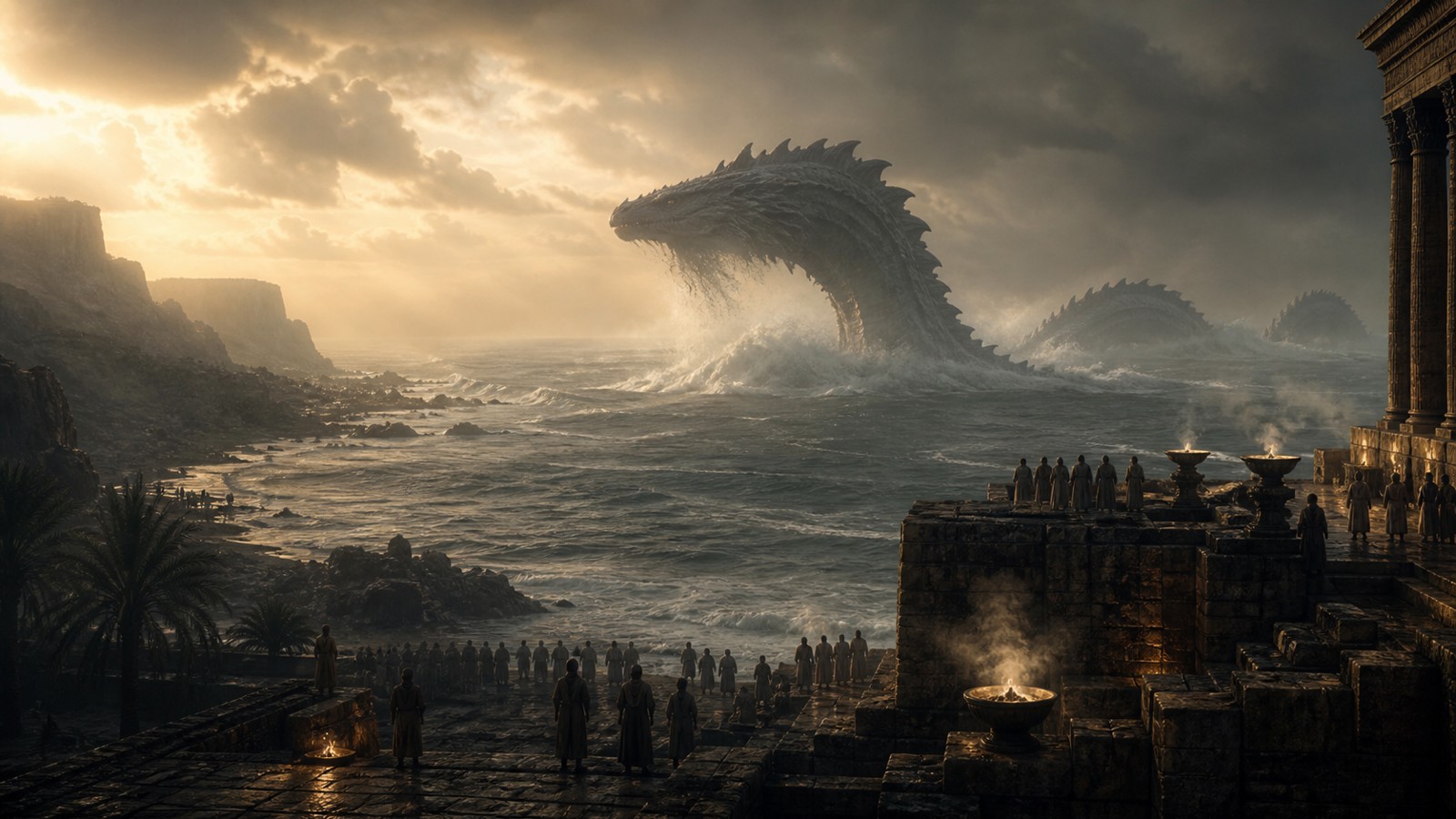
The Kraken Turns the Ocean Into a Creature
The Kraken is one of the most enduring giant sea monsters because it gives shape to the ocean’s oldest fear: something vast may be waiting underneath. Unlike a dragon on a mountain or a beast in a forest, the Kraken belongs to a world humans can only partly see. Sailors can read weather, currents, and stars, but they cannot see far into black water. That uncertainty is the Kraken’s real habitat. This guide explains where Kraken legends come from, how the creature’s powers changed over time, and why tentacles rising from the sea still feel like one of fantasy’s strongest images.
Where Kraken Legends Began
The Kraken is most closely associated with Scandinavian and northern Atlantic sea lore, where sailors told stories about enormous creatures capable of troubling ships and confusing the boundary between animal, island, and storm. Early descriptions were not always the theatrical tentacled monster modern readers picture. Some accounts suggest a massive sea being so large that it could be mistaken for land, reef, or a strange floating mass until movement revealed the danger. That uncertainty made the legend believable in a maritime world where fog, distance, and exhaustion could turn the sea into a place of shifting shapes.
The historical Kraken also grew from practical ocean anxiety. Ships were fragile, navigation was hard, and deep water kept its secrets. A crew might encounter whirlpools, dead whales, giant squid, unusual waves, or shoals of fish driven upward by unseen predators. The Kraken became a way to gather those experiences into one memorable creature, large enough to explain what ordinary knowledge could not.
Giant Squid, Sailors, and the Birth of a Monster
Modern readers often connect the Kraken with giant squid, and that connection is useful, though not complete. Giant squid are real animals, and their long tentacles, deep-sea habitat, and rare appearances make them perfect candidates for sea-monster imagination. Before photography and modern marine biology, a floating tentacle or a decaying body could easily become proof of something larger, stranger, and more dangerous than anyone had measured.
Still, the Kraken is not just a misidentified squid. Folklore does not work like a field guide with errors in the margins. Real animals supplied texture, but the legend also carried fear of drowning, isolation, storms, unknown depth, and the helplessness of being far from shore. The Kraken’s body became a meeting point between observation and dread.
That is why the creature still feels different from a normal giant squid in fantasy. A squid is an animal. The Kraken is the sea behaving as if it has chosen a target.
The Kraken’s Most Famous Powers
The Kraken’s powers usually begin with scale. A creature large enough to grip a ship, darken the water, or create a whirlpool does not need a complicated magical system. Size itself becomes a force. Tentacles can break masts, coil around hulls, drag sailors overboard, or rise like black columns from the water. Even when the body remains hidden, those limbs let the audience imagine a much larger form below the surface.
Whirlpools, Depth, and Hidden Motion
One of the Kraken’s strongest legendary powers is its connection to dangerous water movement. Stories often describe currents, sucking seas, or whirlpools forming around the monster. This makes sense because the most frightening part of the Kraken is not merely that it attacks; it changes the environment. The ocean stops being passive and starts acting with intention.
That environmental power separates the Kraken from many land monsters. A wolf may chase, a dragon may breathe fire, and a giant may throw stones, but a Kraken can make the battlefield itself unstable. Decks tilt. Ropes snap. Visibility disappears behind spray. A ship becomes tiny because the surrounding water has joined the creature.
For visual storytelling, this is gold. The audience does not need to see the entire Kraken. A circular current, a tentacle sliding below the surface, and sailors staring in different directions can create more dread than a full-body reveal.
Why the Kraken Became a Fantasy Icon
Fantasy embraced the Kraken because it solves a useful storytelling problem: how do you make the sea feel alive without turning it into a speaking character? The Kraken gives writers a body for oceanic danger. It can guard a forbidden route, punish arrogance, protect treasure, serve a sea god, or mark the edge of a map where human certainty ends.
The creature also works across tones. In adventure stories, it is a spectacular obstacle. In horror, it is the shape beneath the boat. In mythic fantasy, it can be ancient, almost divine, a remnant from before coastal kingdoms and naval empires. In games, it becomes an encounter that changes space because players must think about water, ship damage, distance, and rescue rather than ordinary combat alone.
Its design is instantly readable too. Tentacles communicate reach, entanglement, and hidden mass. A dragon must be staged carefully to avoid feeling familiar; a Kraken can become frightening with only one limb breaking the surface.
The Kraken also gives ocean stories a memorable center. Storms can be dramatic, reefs can be deadly, and hunger can drive a crew apart, but a named sea monster lets all those pressures gather around one image. The result feels mythic without losing the practical danger of ships, ropes, waves, and cold water.
The Kraken as Symbol
The Kraken symbolizes the unknowable deep. It is not only a predator but a reminder that the ocean is larger than human plans. This symbolism is why the creature often appears when characters are too confident: merchants chasing profit, warriors crossing forbidden seas, explorers assuming every blank space can be claimed, or rulers sending ships where old sailors warned them not to go.
There is also a moral edge to many Kraken scenes. The creature can feel like punishment for greed, invasion, or arrogance, but it can also feel neutral, as if humans simply entered a scale of life where their categories no longer matter. That ambiguity keeps the Kraken interesting. It may be monster, guardian, natural disaster, divine instrument, or misunderstood animal depending on the story.
How to Make a Kraken Feel Believable
A believable Kraken does not need to show everything. In fact, hiding most of the body usually helps. The best designs give readers just enough evidence: suction marks on a hull, a pattern of vanished ships, whales behaving strangely, old sailors refusing a route, or water rising in a circle under a moonlit sky. These clues make the creature feel present before the first tentacle appears.
Movement matters as much as anatomy. A Kraken should not thrash constantly like a decorative effect. Slow, deliberate motion suggests intelligence or ancient instinct. A tentacle that rests against a ship before tightening can be more frightening than immediate destruction because it gives the crew time to understand what is happening.
Scale cues finish the illusion. A ship, cliff, lighthouse, or rowboat helps the reader sense size. Without those references, the Kraken becomes a vague mass. With them, it becomes a problem the human world cannot simply outmuscle.
Why the Kraken Still Works
The Kraken endures because the ocean still has mystery even in an age of satellites and submarines. People know more about marine life than sailors once did, but deep water remains difficult to picture. The Kraken lives in that gap between knowledge and imagination. It asks what might be below the visible surface, and the answer is never entirely comforting.
For creature fans, the Kraken is also a model of efficient design. It needs no crown, weapon, speech, or complicated backstory to dominate a scene. Water, scale, and partial visibility do most of the work. That simplicity makes the creature adaptable without making it weak.
The best Kraken stories understand that the monster is not only in the tentacles. It is in the silence before the sea moves, the rope pulled tight by something unseen, the old warning dismissed too quickly, and the sudden realization that the ship is floating over a living abyss.
That final realization is why the image remains so flexible. A Kraken can terrify children, sailors, scholars, or kings because everyone understands the vulnerability of being above something larger.
What the Kraken Does to Human Confidence
Kraken stories often begin with practical confidence. A captain trusts the ship, the route, the crew, and the accumulated knowledge of previous voyages. Then the water changes in a way no chart can explain. That reversal is central to the creature’s appeal. The Kraken does not merely threaten bodies; it threatens the belief that preparation can master every environment.
This is why the creature works so well in stories about ambition. Merchants may want a faster route, kings may want naval dominance, and explorers may want fame, but the Kraken reminds them that the sea has its own scale of permission. The monster becomes a dramatic answer to overreach without needing to deliver a speech.
For readers, that reversal is satisfying because it preserves the ocean’s dignity. The sea is not just a blue road between human goals. It is an ancient place with pressure, hunger, darkness, and memory.
How Modern Creators Reimagine the Kraken
Modern creators have stretched the Kraken into many forms: prehistoric survivor, magical guardian, deep-sea god-beast, cursed animal, alien-like predator, or colossal ecological force. The most convincing versions choose one emphasis and build around it. A biological Kraken needs muscle logic, feeding behavior, and sensory cues. A mythic Kraken needs ritual, omen, and symbolic consequence. A horror Kraken needs restraint, sound, and the terrible delay before the body is understood.
The creature also benefits from human-scale aftermath. Broken docks, salt-stained churches, missing bells, repaired hulls, and families who still watch the horizon can make the monster feel woven into coastal life. A Kraken that only appears during action scenes may be exciting, but a Kraken that shapes culture feels legendary.
That cultural footprint helps separate one Kraken story from another. The creature may be the same broad idea, but the people who live near it reveal what kind of legend it has become.
A modern Kraken can even be quiet. It may be known through restricted harbors, offerings left on black rocks, scientific instruments crushed below a research vessel, or a migration pattern no one can publish without sounding superstitious. Those choices give the creature room to feel ancient inside a modern setting.
That flexibility is why the Kraken keeps returning. It can be folklore, monster, ecological warning, or mythic judge, and every version still begins with the same unsettling thought: the surface is not the whole story.